

There was a time when cricket broadcasting felt like a celebration of the sport. The build-up shows, the expert panels, the storytelling around players, and the calm and analytical commentary made every tournament/series feel special. The presentation was objective and more inclusive. Humor was always present but it was respectful to everyone involved.
Today, however, the tone feels drastically different. Instead of building anticipation through cricketing context, the presentation relies on sensationalism. The storytelling feels exaggerated and detached from the subtle beauty and unpredictability that make cricket special. Hype has replaced heritage.
The Choking Narrative - When Rivalry Turns Cringe
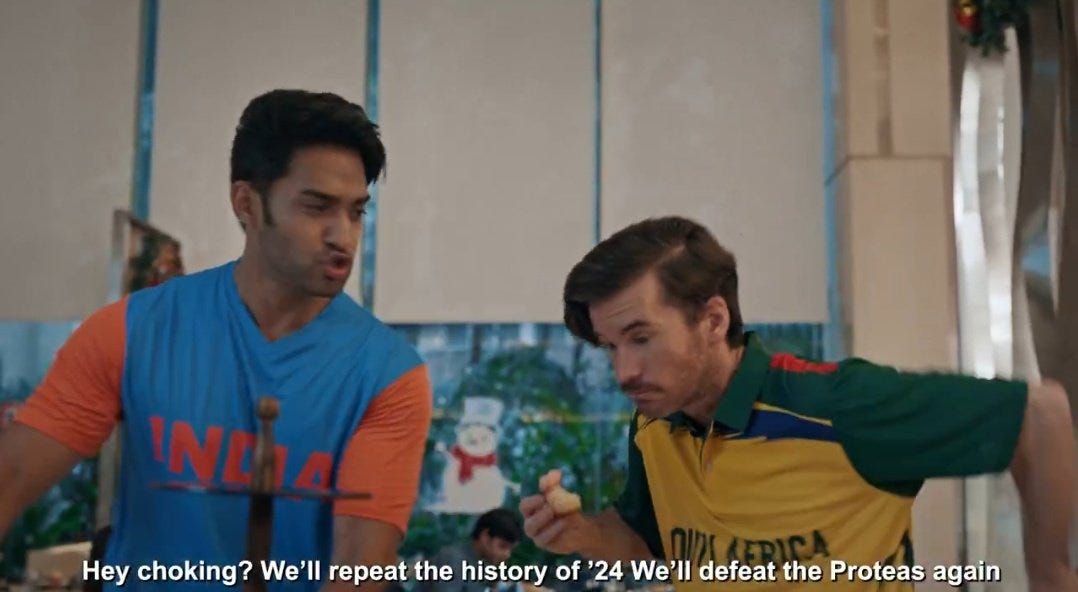
One of the most uncomfortable recent campaigns has been the “choking” angle pushed around the India–South Africa Men's T20 WC Super 8 clash. Instead of building the contest around skill, preparation, and strategy, the promotion leaned heavily into mocking South Africa’s past failures, reducing a proud cricketing nation to a meme.
(The Commercial was taken down after the India-South Africa match, which South Africa won comfortably).
Upset Predictions - Disrespect Disguised As Marketing
Perhaps more problematic is the dramatic framing of matches involving associate teams as potential “upsets.” The language and tone often imply that these teams are merely fillers and are present only to create shock value if they somehow challenge a heavyweight.
This framing is deeply unfair to associate nations who fight for funding, visibility, and respect in global tournaments. When campaigns position their competitiveness as a surprise rather than a possibility, it subtly reinforces hierarchy instead of celebrating growth.
If you’re enjoying reading this post, consider SHARING my newsletter for free with your friends and colleagues, and help my blog reach a larger audience! Come, let’s celebrate and enjoy cricket together!
The Bigger Problem
The common thread across the “choking” ad, “300 alerts,” and exaggerated upset narratives is sensationalism. Instead of trusting the sport’s natural drama, promotions are engineered to provoke reactions - outrage, mockery, or viral engagement. Not to forget the pressure it creates on the team and players who take the field.
But cricket has never needed artificial tension. It has always thrived on respect, rivalry, unpredictability, and depth. When marketing forgets that balance, fans notice. And that’s where the disconnect begins.
The Growing Disconnect
During major events organized by the ICC, we increasingly see creators and influencers filming reels in training areas or producing meme-driven interactions with players. While such content may generate quick engagement, it often lacks cricketing depth. The focus shifts from preparation, tactics, and mindset to viral snippets designed for algorithms.
The 2023 Men's ODI WC theme song is a classic example. Instead of weaving clips of iconic World Cup moments, historic rivalries, or even current cricketers in action, the music video centered on popular entertainment personalities and online creators. The result was Dil Jashn Bole feeling more like a social-media campaign than a cricket celebration.
From Legacy Names to Brand Labels
Another subtle but telling shift has been in how bilateral series trophies are branded and named. Traditionally, these trophies carried emotional and historical weight because they honored human excellence.
The winner of the Test series played between India and England in India is awarded the Anthony De Mello Trophy. It is named after Anthony De Mello who was one of the founding members of the BCCI.
For the series played in England, the winner is awarded the Pataudi Trophy, as a tribute to Iftikhar Ali Khan Pataudi, who happens to be the only player who has represented India and England. The Trophy was recently renamed as Anderson-Tendulkar Trophy, with a new Pataudi medal of excellence announced to be awarded to the winning captain.
India and South Africa compete for the Gandhi-Mandela Trophy, also called the Freedom Trophy. It was instituted as a tribute to the leaders of both the countries.
The Test series between New Zealand and South Africa is called the Tangiwai Shield, which commemorates the Tangiwai Rail disaster that occurred during the Test match between the two countries in 1953.
There are many more. Australia and West Indies fight for the Frank-Worrell Trophy. Australia and Srilanka go against each other for the Warne-Muralidharan Trophy.
Today, however, many bilateral series are introduced primarily with sponsor prefixes, where the brand takes center stage and the historical or emotional identity of the contest becomes secondary. The graphic reads like an advertisement first and a cricket contest second.
When trophies are named after legends, they preserve memory. They remind fans of past captains, iconic tours, and defining moments. When they are reduced to temporary brand identities, that continuity weakens.
It may seem like a small change, but over time, these shifts contribute to the larger disconnect, where commerce increasingly dominates culture in modern cricket broadcasting and promotion, sometimes at the cost of the game itself. I understand commerce is important for the growth of the game but how helpful it is if it sacrifices quality and integrity.
The Contrast - Pepsi “Change The Game” Campaign
Where modern campaigns sometimes chase virality through shock narratives or influencer-driven content, the Men's ODI World Cup 2011’s promotions trusted the game and its icons.
They didn’t reduce opponents to memes.
They didn’t sideline cricketers for creators.
They didn’t manufacture drama.
They celebrated cricket and that’s why fans connected so deeply with it.
Many of the tournament promos highlighted iconic, signature shots of players and that helped generate excitement before the start of the World Cup:
Virender Sehwag – Upper Cut
MS Dhoni - Helicopter Shot
Tilakaratne Dilshan - Scoop
Harbhajan Singh - Doosra
Kevin Pieterson - Switch Hit
Shakib Al Hasan - Super Scoop
The promos even covered umpires with a dedicated advertisement to highlight Billy Bowden's unique bended finger dismissal (which happens to be because of Arthritis).
What Can We Do Better?
Sports means something. To be humble in both victory and defeat. To treat your opposition with respect. What happens on the field stays there. Not every match or series is about revenge. It necessarily does not have to be about 'BADLA'. Maybe it's time we go back to the basics. To enjoy the game for it's beauty.
Cricket deserves coverage that respects its depth, its history, and the players who make it great and not just campaigns designed for clicks. It ought to be inclusive and objective. Broadcasting popularized the game beyond anyone's imagination. I hope it doesn't become the reason that kills it.
Maybe consider buying me a cup of coffee?
While everything on CFC is free to read, we have been a reader-supported platform since the beginning Your support helps me sustain this dream and to keep researching, writing, and traveling to cricket grounds to bring you stories that matter.
Maybe consider buying me a cup of coffee?
New story drops every Wednesday!
In this blog, I unearth forgotten gems, celebrate historical triumphs, and explore the finest literature from the world of cricket.
If you find these stories meaningful, or if they show you why cricket is important on and off the field, consider sharing them or subscribing.
You may also like:

Cricket Max - A Unique Cricket Experiment

Martin Crowe developed Cricket Max as a response to what he perceived as a need for a more exciting, television-friendly version of the game. His goal was to create a format that would be more accessible to new audiences while still maintaining the core elements of cricket.