A Rivalry Unlike Any Other
Not every great rivalry is born in history books or political chambers. Some grow quietly, match by match, tour by tour, shaped less by geography or empire than by the slow accumulation of contested moments. The cricket rivalry between India and Australia is precisely that: a relationship that has evolved organically, earning its weight through the quality of what has unfolded between the two nations on the field.
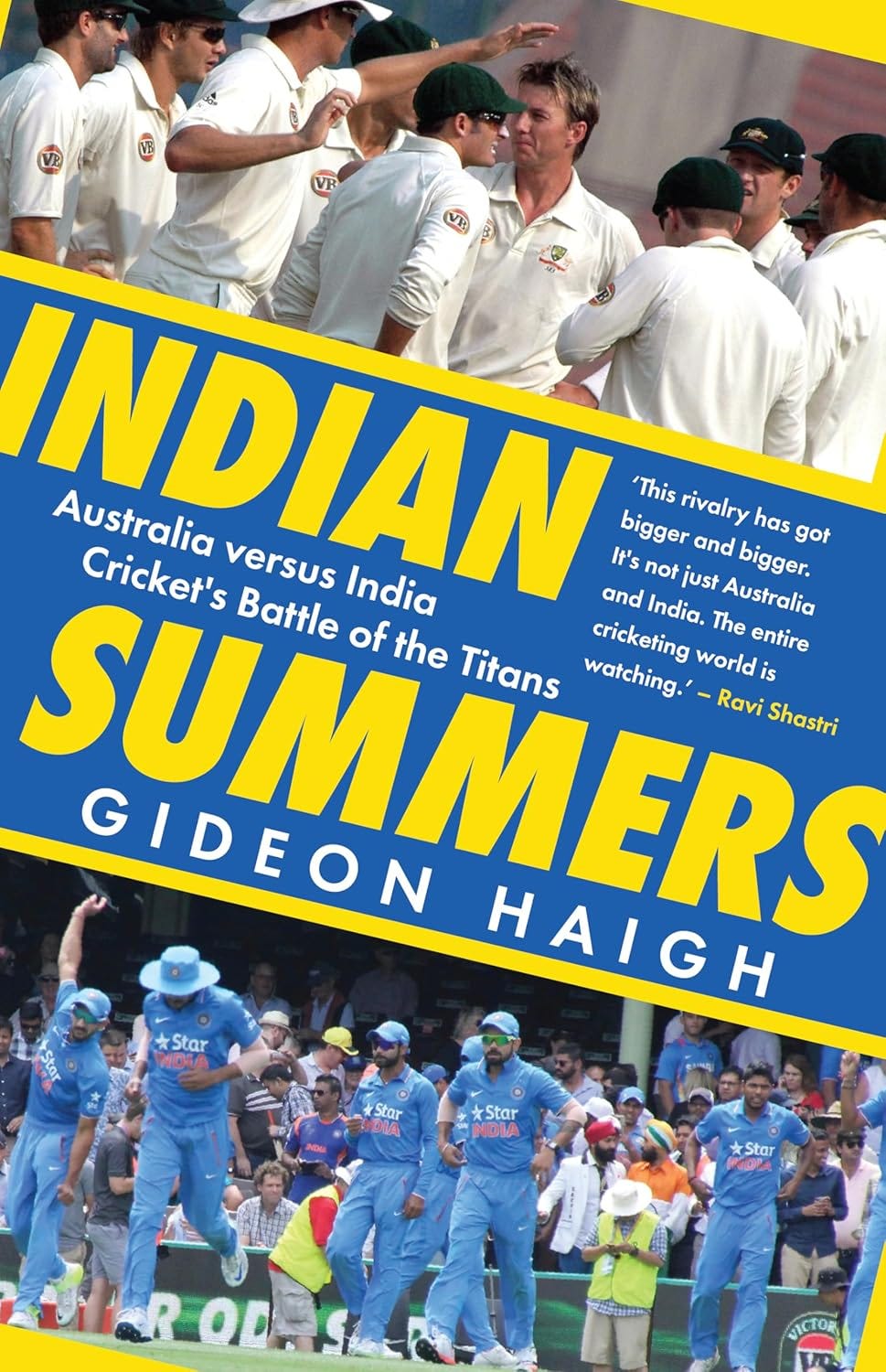
From the Gabba to the Eden Gardens, this is a rivalry etched in cricket. And yet, for all the drama it has produced, a comprehensive written account of it had remained conspicuously absent. Indian Summers sets out to fill that gap.
A Collection of Dispatches
This is not a linear narrative - no chapter depends on the one before it, and the reader seeking a neat chronological arc will need to adjust their expectations. What Haigh offers instead is a collection of independent dispatches: finely crafted essays on matches and tours that have defined the India-Australia contest across nearly a century of cricket, from the first tour of 1935 right through to the Border-Gavaskar Trophy of 2025.
The Prose: Poetry in Whites
If there is one quality that elevates Haigh above other cricket writers, it is his refusal to settle for the merely accurate when the precisely beautiful is within reach. He blends the rhythms of poetry with the rigour of commentary.
Haigh’s descriptions of cricketers are so precisely observed that they linger long after the page is turned. Consider how he captures Virender Sehwag: no batsman, he writes, radiates such an air of relaxation at the crease. In that single clause he says everything - the swagger, the stillness, the absolute absence of doubt. Of Sachin Tendulkar, he writes that the man is a symbol of change but also of continuity - a formulation that rewards reflection, holding within it the whole arc of Indian cricket’s transformation and the one constant at its centre.
This is Haigh’s gift: the ability to compress a career, a personality, or a defining characteristic into a phrase so apt it feels inevitable. He knows when to hype and when to simplify, when to let an occasion breathe and when to press the language until it yields something essential.
The Players: A Gallery of Forgotten Greats
The book’s most moving chapters belong to the cricketers who have faded from popular memory. These are players whose contributions are now buried beneath decades of records and highlights that did not survive the analogue age.
The portraits of Mohinder Amarnath, Gundappa Vishwanath, Chandrashekhar, Bishan Bedi, Dilip Doshi, Ricky Ponting, Michael Clarke, Kapil Dev, and Sunil Gavaskar are among the book’s finest passages. These are not statistical summaries but character studies. More so explorations of individuality, temperament, and the kind of cricketing personality that resists reduction to a scoreline.
Reading these chapters, one is struck by a quiet melancholy: a sense that these men represented something in the game that cannot be mass-produced, something formed by adversity and coloured by the particular texture of their times.
What Haigh achieves, at his best, is the feeling of knowing these cricketers - not just their averages or their famous innings, but the manner in which they inhabited the game. That is a rare and generous thing for a writer to offer.
Cricket as Cultural Commentary
To read this book only as a record of cricket would be to miss half of what it offers. Haigh uses the India-Australia rivalry as a lens to examine everything that has changed and much that has been lost.
His observations on the diminishing idea of a team in an era of excessive scheduling are sharp and unsentimental.
His commentary on the growing influence of broadcasters on cricket decisions, the rise of private leagues, and the erosion of Test match temperament among modern players carries the weight of someone who has watched the game closely enough to know precisely what has been surrendered in the name of commerce.
He writes as a fan who feels the disappointment acutely, and who is bold enough to say so. Readers will not agree with every assertion. Nor are they meant to. But they will find it impossible not to respect the clarity of thinking and the honesty of the concern. There is context to every argument, candour in every critique, and never the sense that Haigh is grandstanding. He is simply telling the truth as he sees it.
A Book That Deserves to Last
Revisiting the tours of yesteryears through Haigh’s essays is nostalgic. The India of the 1970s tours, the Australia of Border and Lillee, the subcontinental conditions that flattened touring sides and the pace attacks that did the same - all of it is reconstructed with the detail of a scholar.
This is not the easiest cricket book to read. But it may well be the most rewarding. In its candour, its poetry, its refusal to flatten the game into results, it stands apart from the crowded shelf of cricket literature. Haigh has given this rivalry the account it deserved. And for that very reason, this book is a worthy read.
My Rating
3.5/5
Maybe consider buying me a cup of coffee?
While everything on CFC is free to read, we have been a reader-supported platform since the beginning. Your support helps me sustain this dream and to keep researching, writing, and traveling to cricket grounds to bring you stories that matter.
New story drops every Wednesday!
In this blog, I unearth forgotten gems, celebrate historical triumphs, and explore the finest literature from the world of cricket.
If you find these stories meaningful, or if they show you why cricket is important on and off the field, consider sharing them or subscribing.
The Game You Know, Stories You Don’t!
Find your next cricket read:
CFC Podcast: Freshly brewed cricket conversations
Episode 1: Stories on Women's Cricket and forgotten legends of Indian cricket

In my debut conversation, I sit with Aditya Bhushan, author and cricket writer, to delve into the history of women's cricket in India. He shares fascinating stories about the pioneers such as Shubhangi Kulkarni, Aloo Bamjee, Diana Edulji and M.K. Sharma.
Want to Read More of My Writing?
I also write newsletters about travel and food. If you are looking for travel ideas and itineraries or just want to read fascinating travel stories, you should consider following Backpack Chronicles by clicking the buttons below: